
A HISTORY OF OUTSIDE INFLUENCE
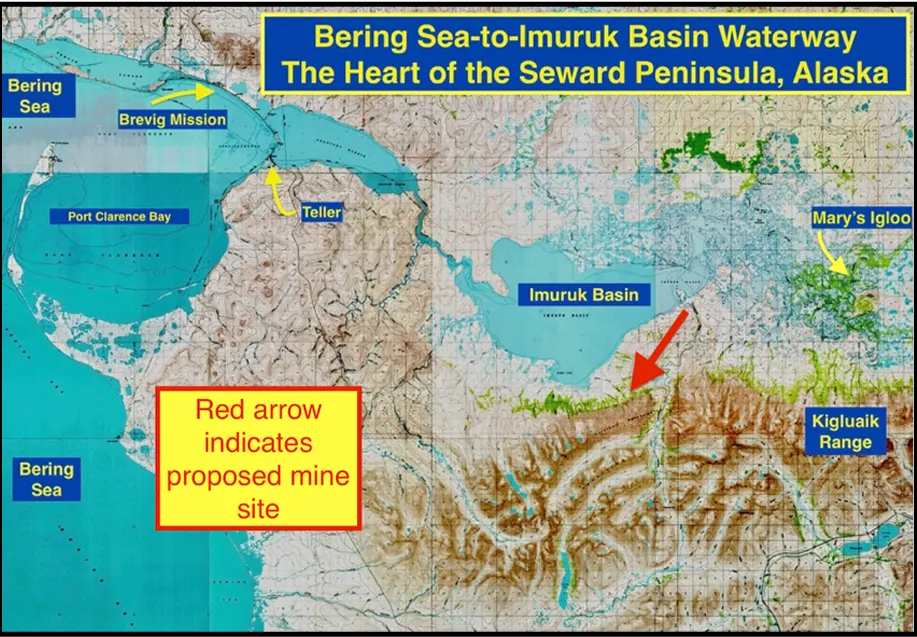
Outside influences have shaped both settlements along the Bering Sea-to-Imuruk Basin Waterway. In 1892, Alaska’s General Agent of Education Sheldon Jackson brought reindeer to the north shore of Port Clarence Bay (see map below) to feed people whom he claimed were starving. The resulting settlement was called Teller Reindeer Station. It is now known as Brevig Mission. Documentation shows that Jackson’s second motive for bringing reindeer to the area was to establish an industry that would entice more outsiders to the region.
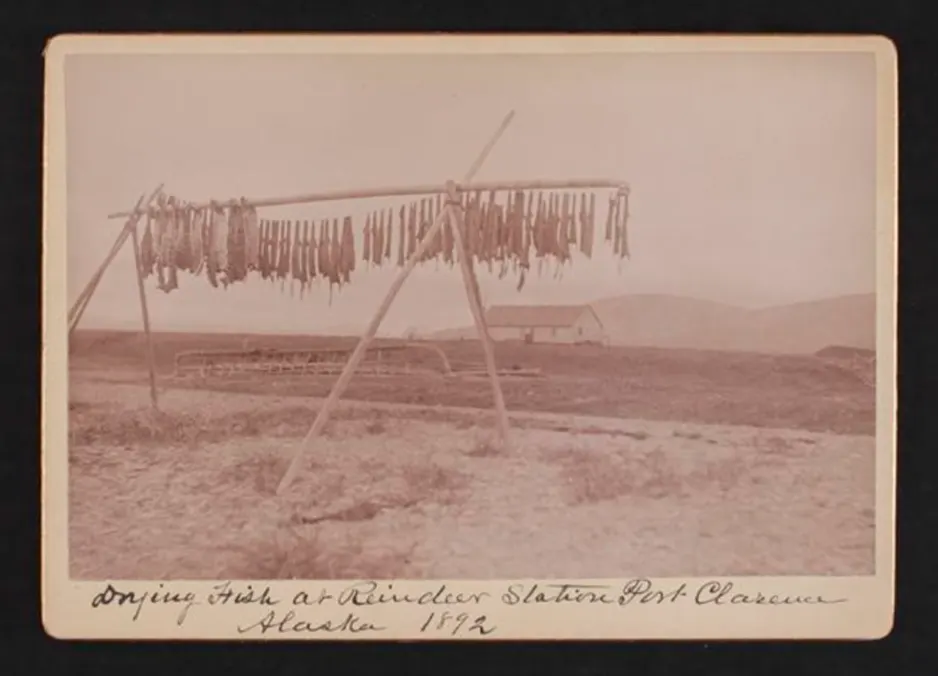
Picture: Presbyterian Historical Society, Digital Collection. Sheldon Jackson Archives.
The village of Teller lies six miles across Port Clarence Bay. It was bursting at the seams when 5,000 gold miners occupied the spot in the early 1900s. (Members of the Mary’s Igloo tribe relocated to Teller after 1948 when the BIA school closed.)
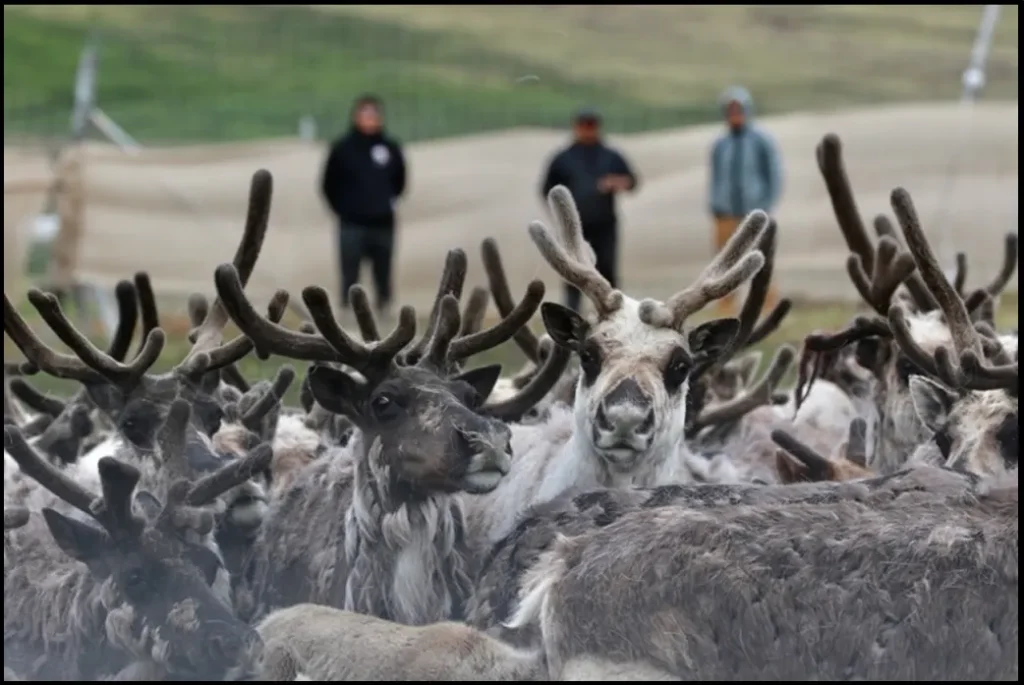
Picture: The Olanna Herd in Brevig Mission and the Kakaruk Herd in Teller are still active, 134 years after reindeer were introduced to Alaska at the Teller Reindeer Station, now known as Brevig Mission.
The Canadian mining company Graphite One is another in a long line of outsiders looking to take advantage of the lands and waters vital to fishermen (and women) and hunters living along the Bering Sea-to-Imuruk Basin Waterway. (Google Port Clarence commercial whaling resupply station; turn-of-the-century Gold Rush; U.S. Army WWII airbase, and U.S. Coast Guard LORAN-C Station on Point Spencer).
Graphite One covets land adjacent to the Imuruk Basin to dig a hole in the ground that is currently reported to be 1,340 feet deep and 1.1-miles-long. That would make it the largest artificially created hole in Alaska history.
Side Note: The proposed mine’s footprint is only 1.5 miles from the nearest documented salmon stream. Five species of salmon use Imuruk Basin as part of their spawning journey.
THE MYTH OF GRAPHITE ONE’S COMMUNITY ENGAGEMENT
The mining company’s propaganda-based script for community engagement in Brevig Mission and Teller over the past decade starts with a 5–8-person entourage arriving by chartered plane. They hustle over to the community hall with food and boxes of trinkets. My wife Annie, a Brevig Mission tribal member, calls the latter “blue trade beads.”
Then they begin setting up their PowerPoint slideshows. As the villagers are finishing their pizza or Subway sandwiches, Graphite One reps begin talking. They don’t ask for a village elder to deliver a prayer. Instead, they bring their own “pastor,” who proclaims Graphite One’s blessing. This amounts to a reminder for the people to do the proper thing, which means supporting the miner’s efforts. Graphite One also tells the people they need to be patriotic and accept the risks to their subsistence lands and waters because the country needs graphite for electric car batteries.
Next, several company representatives talk to (or rather at) the crowd for a mind-numbing amount of time. This is evident from listening to audio recordings of the two most recent events. When Graphite One visited Brevig Mission in May of 2025, no Native voice was heard until the one-hour, thirty-five-minute mark. At the June 2026 meeting across the bay in Teller, no Native voice was heard until the one-hour, six-minute mark.
It’s not until after their long speeches conclude that the company responds to a few questions. It then holds a raffle that includes their own sweatshirts and ball caps.
Side Note: The company has given the Brevig Mission, Teller, and Mary’s Igloo tribes $50,000 each of the past three years. To put that into perspective, there are nearly 500 people in Brevig Mission, so that comes out to roughly $100 per person. Annie calls it bribery. She says that the mining company is offering her people small amounts of money and a few low-paying, entry-level jobs to persuade them to destroy their own traditional fishing and hunting grounds. She says that trading short-term, single-generational employment for a “forever” hole filled with the companies’ toxic waste products is a very bad deal!
Side Note: Google searches have revealed that Graphite One’s two primary “community engagement” reps, VP Michael Schaffner and VP Kevin Torpy, make between $500,000 and $800,000 annually, depending on achieved incentives. Each year, this pair has over a million reasons to exploit the waters and land around the Imuruk Basin. These guys have become multimillionaires off this project. Annie calls this a perfect example of corporate greed.
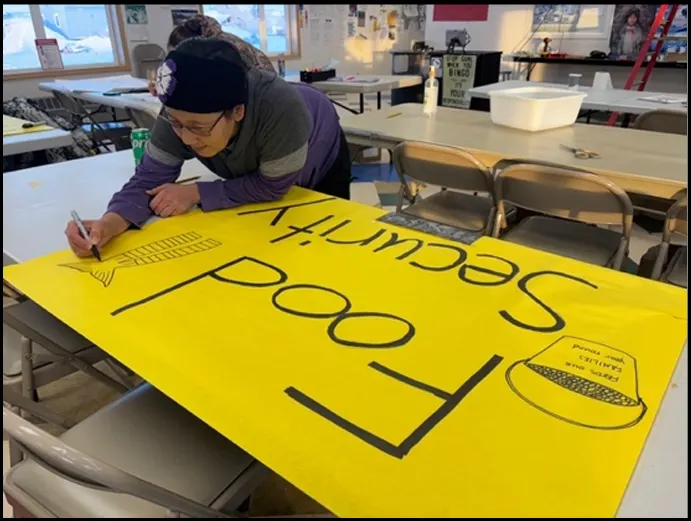
Picture: Lolo Olanna creates a sign in preparation for a visit from Gregory Mazer of the United States Army Corps of Engineers (USACE) in April.
Side Note: The federal government has awarded 37.5 million dollars of U.S. taxpayer money to Graphite One, a private, foreign mining company.
THE MYTH OF GOVERNMENT-TO-GOVERNMENT CONSULTATION
This past spring, Gregory Mazer, the lead for the United States Army Corps of Engineers (USACE) in Alaska, and his assistant were planning their first visit to the villages for mid-April 2026. USACE would be bringing a group of four from the State of Alaska. Neither institution had been to Brevig Mission to listen to public concerns before this visit. The government’s main goal was to give presentations about the permitting process. They stated, however, that the people in Brevig Mission should not consider their visit as government-to-government consultation.
Like the mining company, USACE scheduled their meetings without consulting the three tribes living along the Bering Sea-to-Imuruk Basin Waterway. Instead, they sent a public announcement to the Nome Nugget newspaper inviting people to attend meetings “hosted” by USACE in Brevig Mission, Teller, and Nome. USACE announced that Graphite One representatives would be included in their entourage.
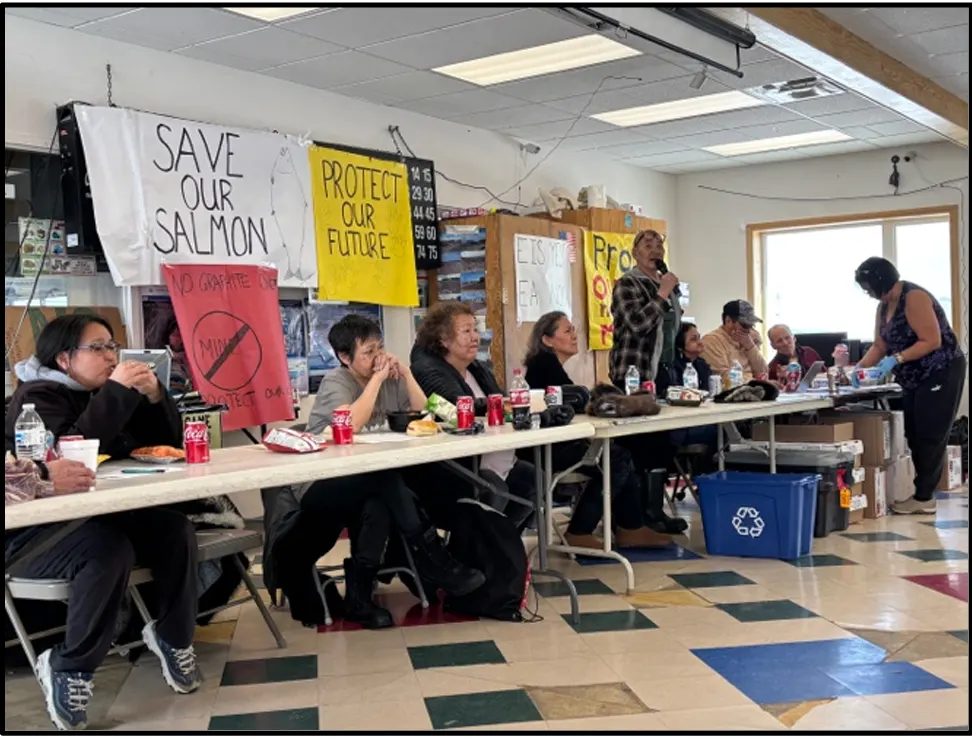
Picture: Native Village of Brevig Mission tribal president Gilbert Tocktoo starts the public meeting in Brevig Mission hosted by the town’s tri-entities in April. Their guests were representatives from the federal and state governments.
USACE’s posting motivated the people of Brevig Mission to break the cycle of “brainwashing,” as Annie calls it. The Brevig Mission tribal council president Gilbert Tocktoo had several objections and asked me to help him draft a letter to Mazer.
Gilbert’s message was that 1) the tribe objected to USACE announcing itself as hosts. He wanted to make it clear that, in fact, the council, city, and village Native corps were the hosts; and 2) on behalf of the tribe and his village, he objected to the concept that the agencies who should be neutral were bringing the company they were evaluating to meet with a tribes that was objecting to the intrusion.
Gilbert concluded by telling USACE that Graphite One was not invited at that time.
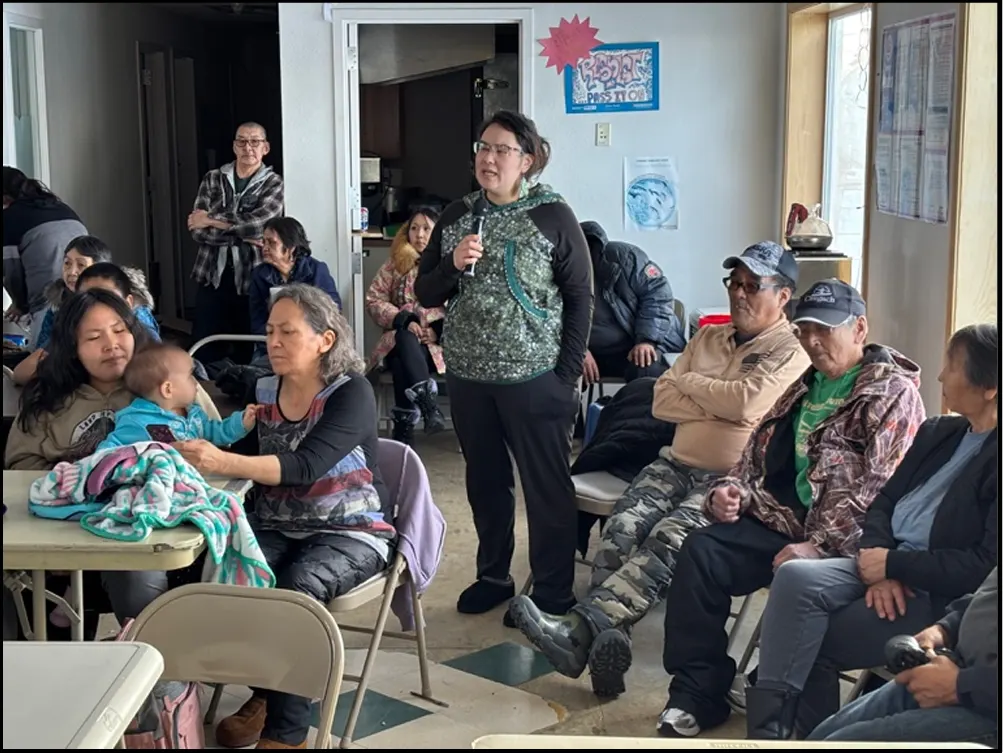
Picture: Brevig Mission tribal council member Frieda Southall addresses USACE and State of Alaska representatives. She raised one of many concerns about the proposed graphite mine, which would run 24/7, 365 days a year.
GOVERNMENT REPS ARRIVE WITHOUT GRAPHITE ONE
The Brevig Mission tri-entities (tribe, city, and Native corps) then created a plan for the upcoming visit by USACE and state representatives. They decided to run the get-together as a joint meeting with all three councils sitting at or near the front of the room, rather than scattered around as if they were members of an audience attending a lecture.
Gilbert started the April 15 meeting by introducing the event. He then asked the council members to introduce themselves and invited the tribe’s guests to do the same.
Next, tribal council member Frieda Southall gave the prayer. She stated, “Lord, I ask that we work together for the best interests of our community, our food security, our culture, and preserving our culture. Most importantly, Lord, I ask that you open the eyes and the hearts of those who must decide on Graphite One to see the lives that will be severely impacted.”
After the prayer, the council invited members of the public to make comments and ask questions. That part of the meeting lasted an hour and a half. Many, many Native voices were heard. The tribe allowed USACE and the state reps to defend their actions. Then the government agencies were given time to deliver slideshows.
Throughout the meeting, tribal members shared subsistence foods with their guests.
If Brevig Mission’s objections to the mine were not clear to USACE and the State of Alaska decision-makers before this meeting, they were certainly clear to them after.
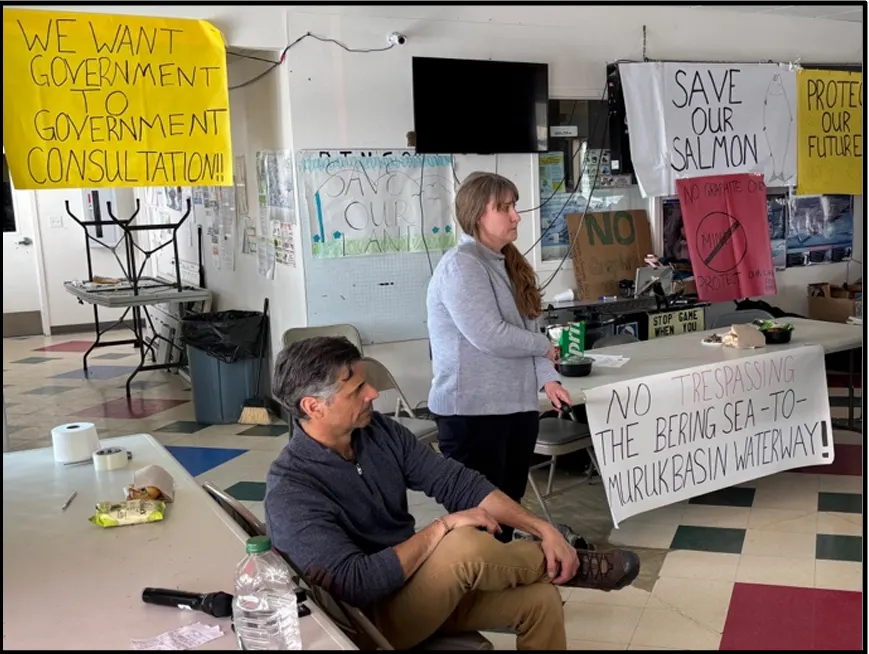
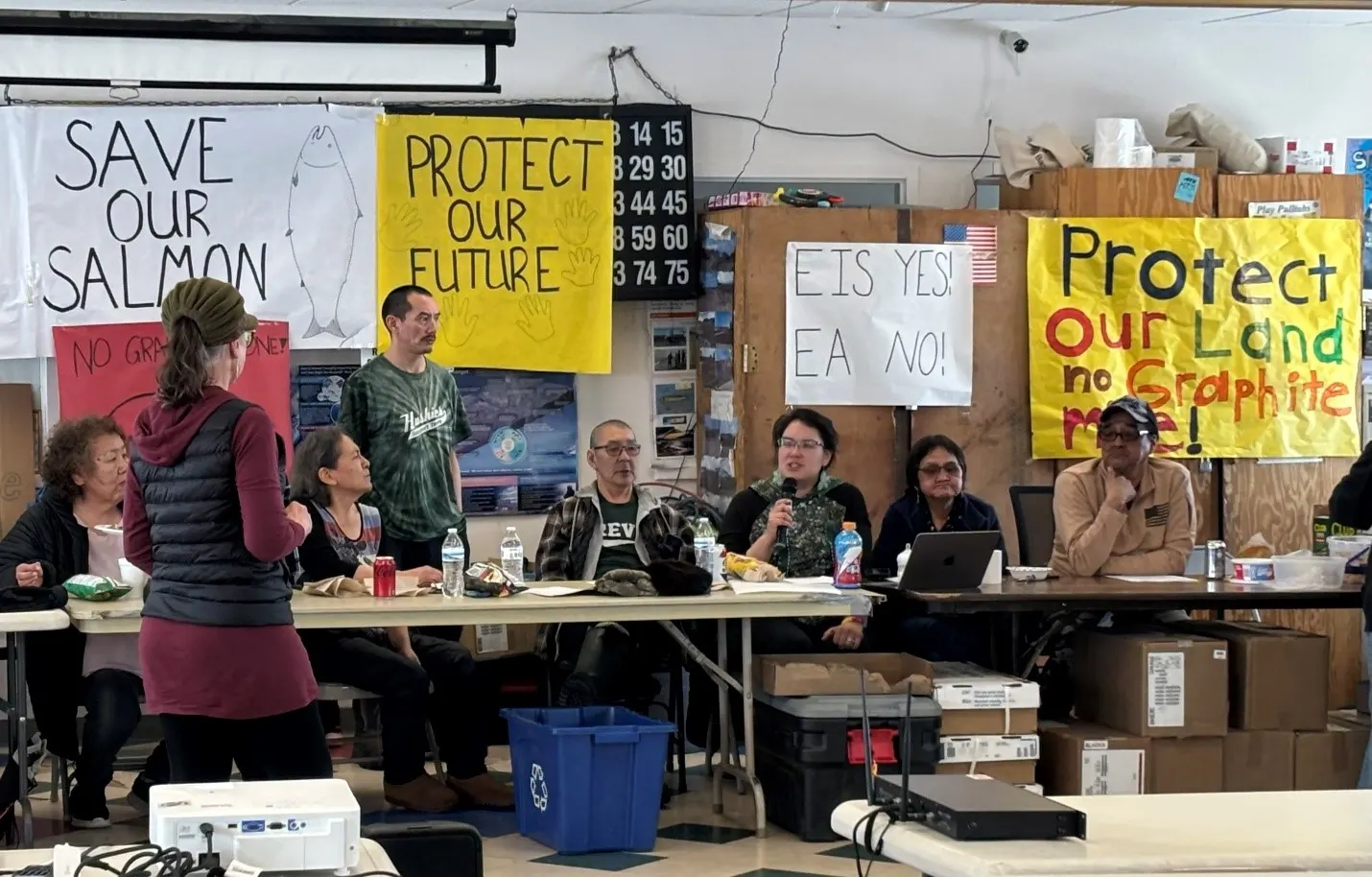
Picture: Brevig Mission’s words and posters made their objections to the proposed graphite mine clear to USACE representative Gregory Mazer (seated) and the reps from the State of Alaska during their April visit to Brevig Mission.
Still, that knowledge did not dissuade one State of Alaska representative from presenting an announcement to a room crowded with concerned people and lined by oppositional posters. She stated that the number of comments from the village would not influence her permitting decision. She was referring to the flurry of over 100 comments submitted by Brevig Mission tribal members after a community meeting in November.
Perhaps her statement was made because few villagers have computers, so they used pencil and paper to write down their thoughts. Perhaps she didn’t know that many had no email addresses. Perhaps she didn’t care that many had no phones. Still, over 300 comments were submitted to USACE, nearly all in opposition to this mining project.

Picture: Rebecca Jones holds up over 100 handwritten comment letters from Brevig Mission residents objecting to the proposed graphite mine in their traditional fishing and hunting grounds.
GRAPHITE ONE IS UNINVITED A SECOND TIME
As has happened repeatedly over the past 10 years, Brevig Mission learned about Graphite One’s next round of public meetings through a newspaper announcement. It stated that the mining company would be in Brevig Mission on June 1. The tribe said NO.
In a press release dated 05/31/26, the tribal council stated, “This meeting date was set by the company without tribal consultation. Graphite One’s chosen date coincides with a time that the ice is moving out of Port Clarence Bay, a crucial period for tribal members to take part in vital marine mammal harvesting activities… The Tribal Council remains open to collaborative dialogue with Graphite One to establish an appropriate meeting time. The tribe does have concerns.”
That rebuttal seemed to do the trick because later in the summer, Graphite One approached the tribe to arrange a proper meeting date. They settled on July 28. By then, village freezers would be full of seal and salmon, and Arctic entryways would hold lots of dry fish.
In response to the tribe’s opposition to several of their own regional corporation’s actions, two members of the Bering Straits Native Corporation (BSNC) flew in with Graphite One. BSNC has invested millions of shareholders’ dollars in the proposed mine without consulting them. In Graphite One’s last meeting in Brevig Mission (May 2025), they referred to the Bering Straits Native Corporation as “our bosses.”
Brevig Mission tribal members emphasize that they feel unprotected by the company’s bosses. The Bering Straits Native Corporation rep responded to the villagers’ concerns by stating that his corporation had bought “a seat at the table.” But the shareholders from Brevig Mission, Teller, and Mary’s Igloo have no seat at the table, even though the table is in their own kitchen.
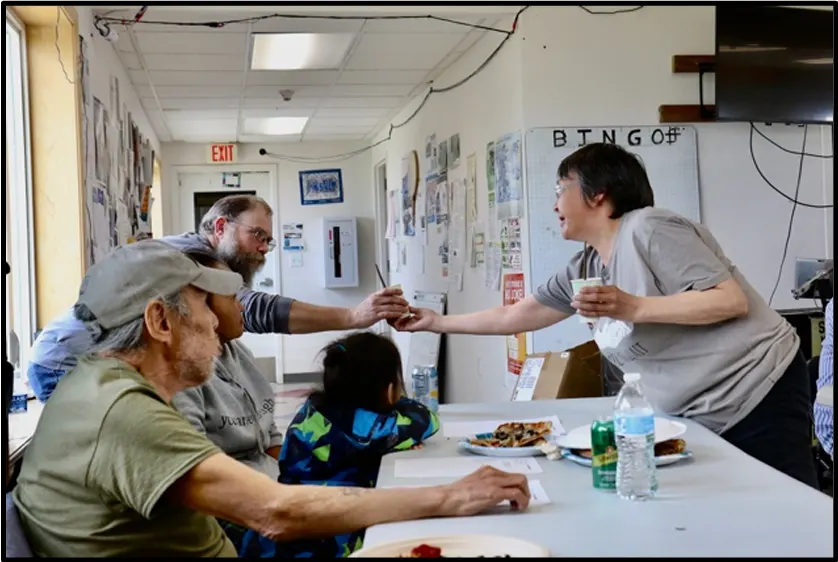
Picture: Brevig Mission Native Corporation board member Sally Okealuk offers traditional Native foods to a biologist on the Graphite One payroll. This act emphasized the importance of wild foods to the villagers’ survival.
Brevig Mission’s April meeting with USACE served as a template for their July get-together with Graphite One. The event was run as a joint meeting. Gilbert made introductions, and Frieda gave the invocation. They were followed by a segment featuring questions and comments by village residents, which lasted until the one-hour, fifty-minute mark.
It was evident that after 10 years of being lectured to and disregarded, the subsistence dependent people of Brevig Mission had a lot to say to Graphite One (and to BSNC).

Picture: One of many posters created by Brevig Mission residents for meetings over the past 10 months.
It should be noted that even before the April meeting, USACE had decided to conduct an Environmental Assessment (EA) to evaluate the mine’s potential effects. An EA is a non-thorough evaluation, to say the least. Historically, an EA has been considered woefully inadequate for such massive projects in sensitive and remote areas.
Then, early this summer, the tribes of Brevig Mission, Teller, and Mary’s Igloo were informed that USACE had reversed course and would now call for a full Environmental Impact Statement (EIS).
This decision proves that when villages speak out, they can be heard. But big problems remain. The governmental agencies are using ecological and archaeological data collected by organizations employed by Graphite One. Those hired are not neutral entities!! They work for the company and its bosses, not the public.
PICTURES FROM THE JULY 28, 2026, MEETING WITH GRAPHITE ONE
Each caption includes the tribal member’s stated concerns.
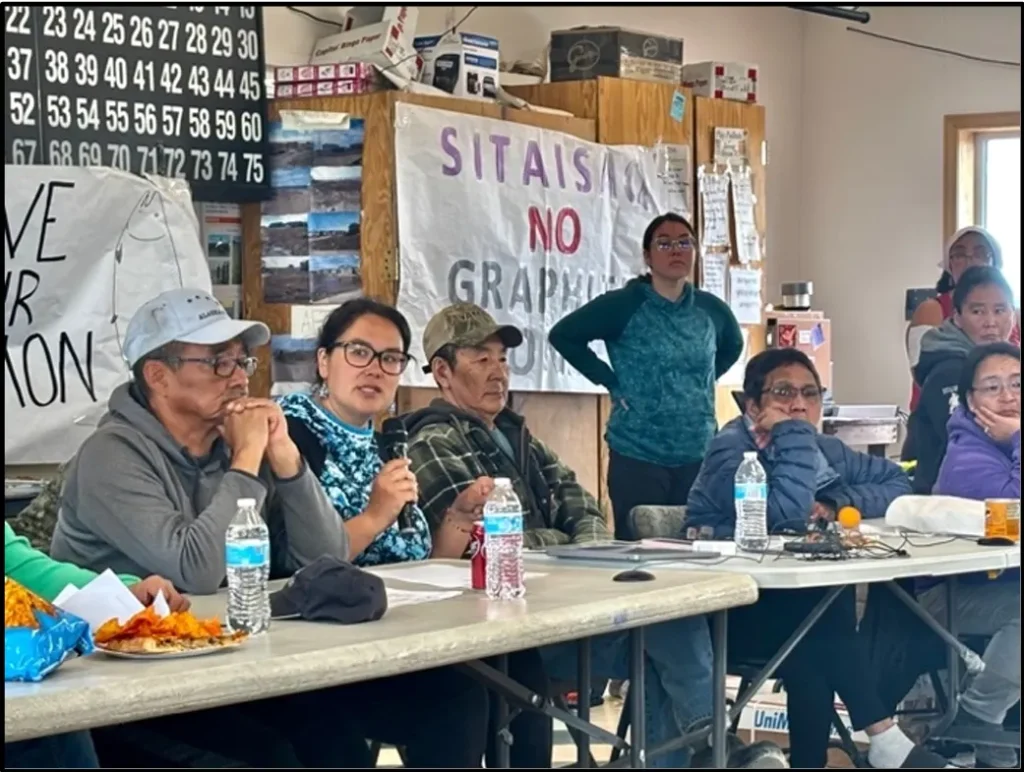
BERING SEA-TO-IMURUK BASIN WATERWAY – Frieda Southall objected to Graphite One’s desire to use the salmon and marine mammal-filled waters that lead from the Bering Sea to Imuruk Basin. She also asked the Bering Straits Native Corporation to bring Brevig Mission’s concerns to the state level.
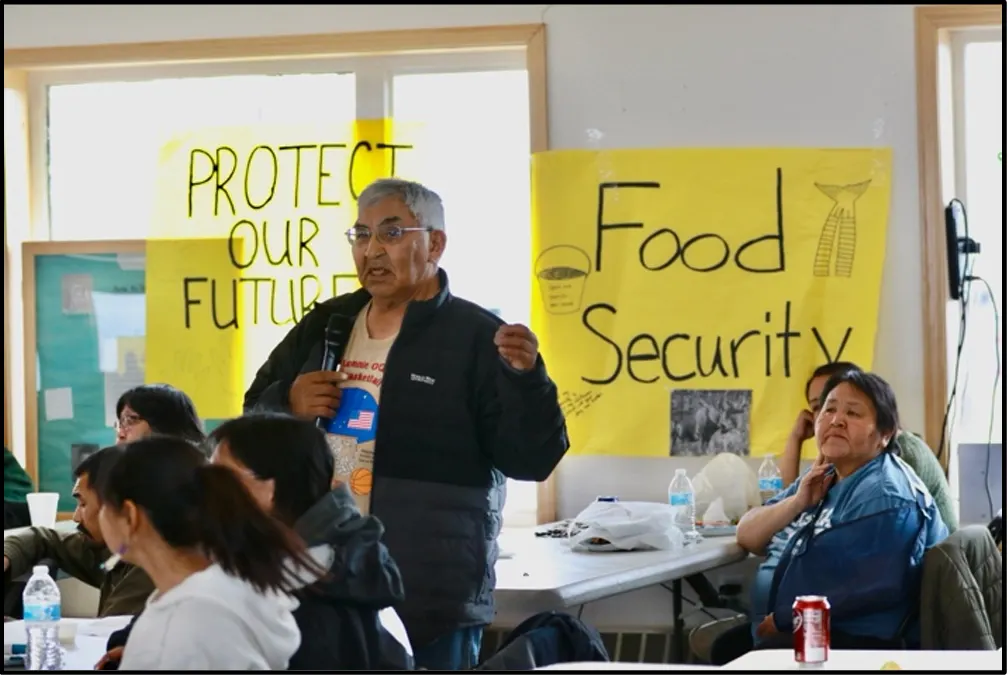
LACK OF CONSULTATION – Elder Elmer Seetot Jr. spoke about the lack of consultation with local tribes.
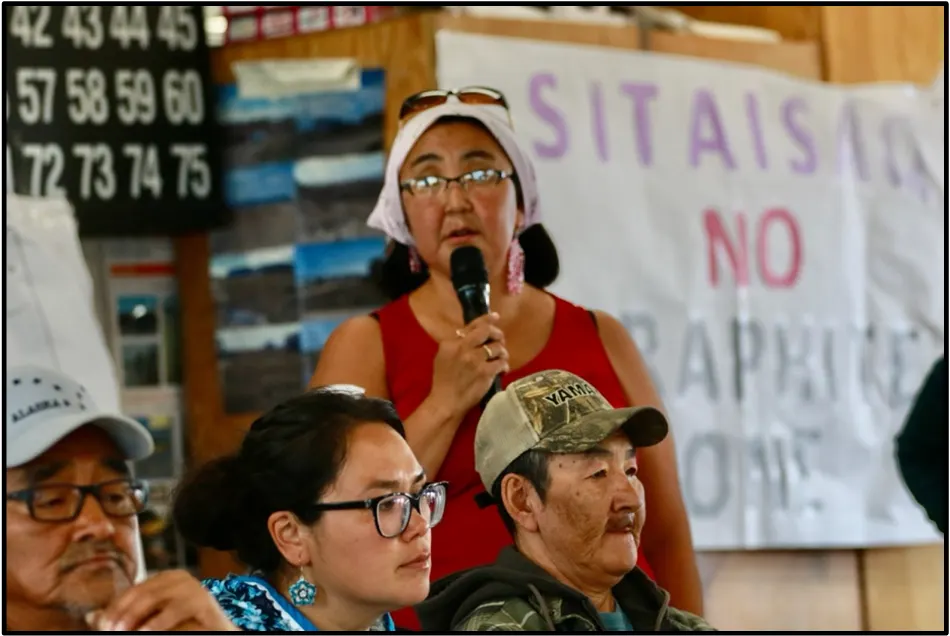
FOR THEIR KIDS AND GRANDKIDS – Brevig Mission Tribal office coordinator Darla Tocktoo told representatives of Graphite One and the Bering Straits Native Corporation about the importance of the village’s future food security. She also told Bering Straits Native Corporation reps that they should have consulted the tribes before agreeing to participate in this project.
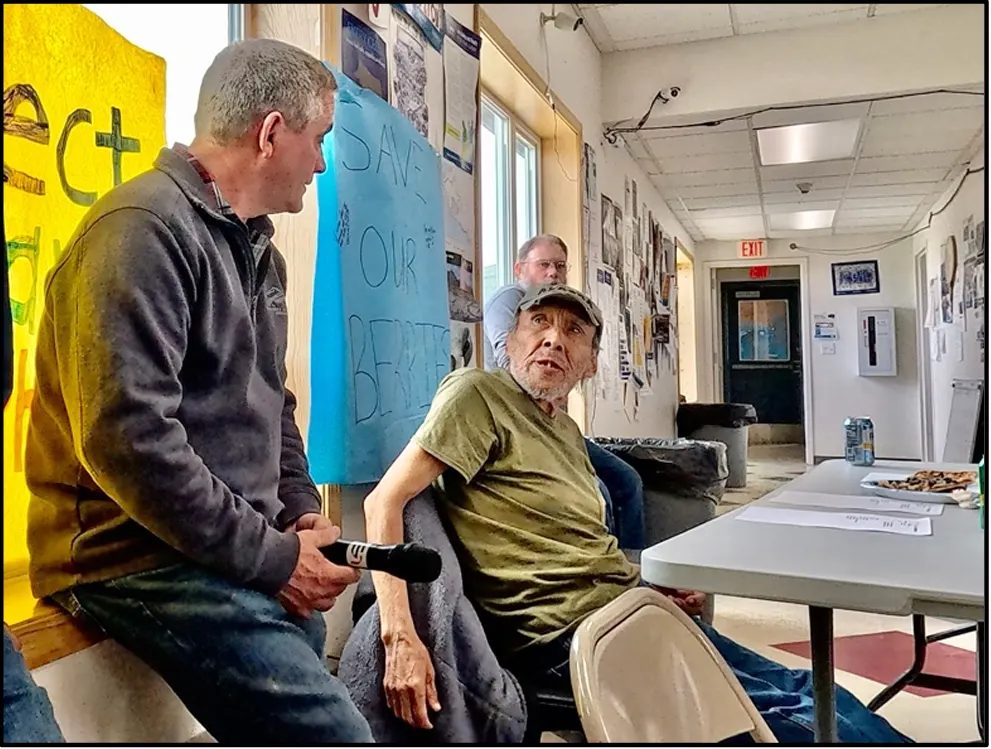
CALL FOR HONESTY AND TRANSPARENCY – Brevig Mission Native Corporation President, Reggie Barr, asks Graphite One Vice President Michael Schaffner for honesty and transparency in future dealings concerning the developing Environmental Impact Statement.
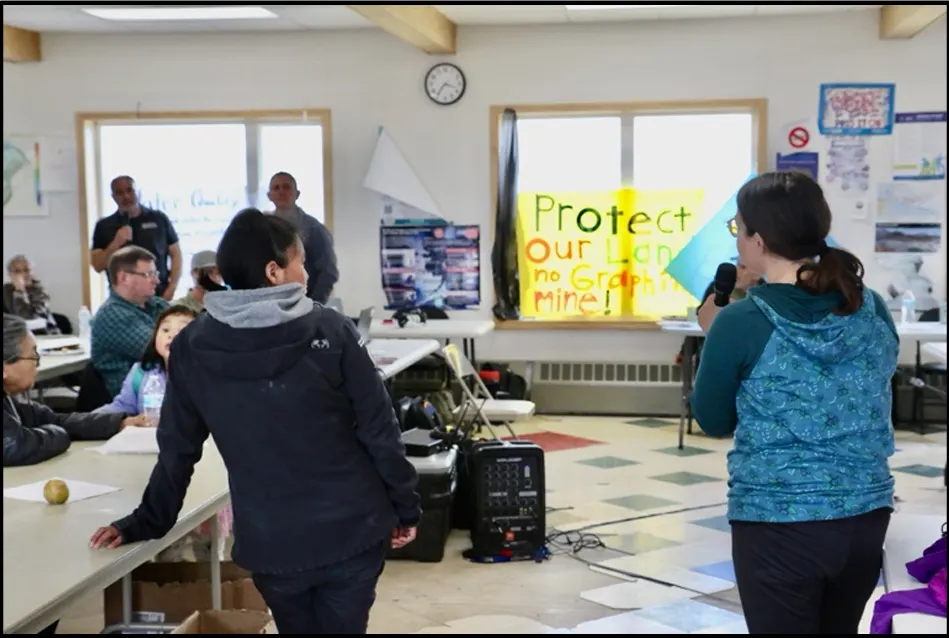
NEED FOR SHAREHOLDER CONSULTATION – Brevig Mission Tribal Coordinator, Stephanie Olanna, right, addressed Bering Straits Native Corporation Vice President of In Region Operations, Larry Pederson, standing far left. She insisted that BSNC provide direct consultation between all shareholders in the future.
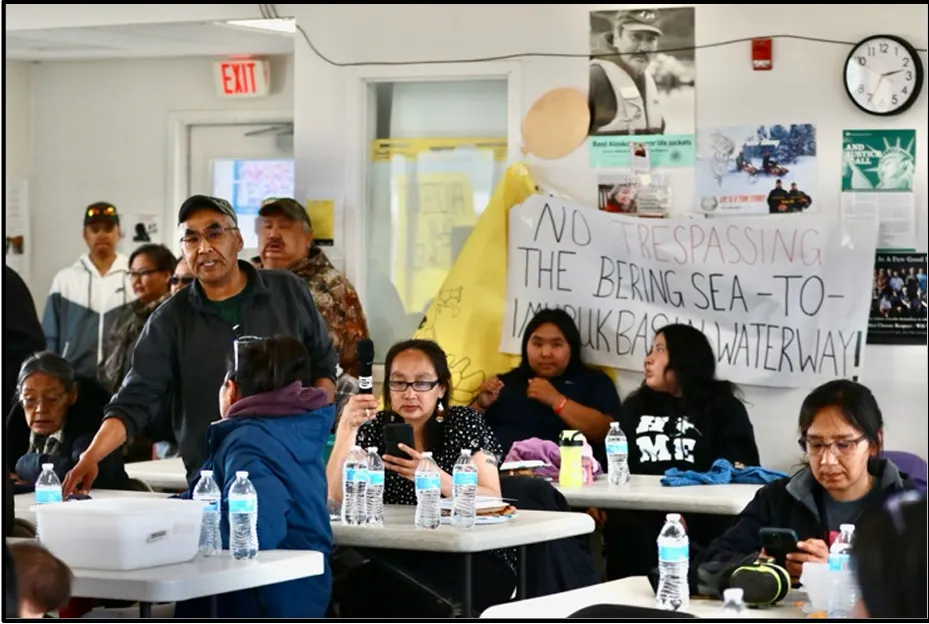
CAUSING MOTHER EARTH HARM – Brevig Mission resident Edward Tocktoo stated that the proposed mine would hurt Mother Earth and be too close to Imuruk Basin.